A custom web application is your way of working, in an interface, not one more spreadsheet.
Custom web application development services cover the design and build of software that runs in a browser and is built around a company’s real processes: internal tool, client portal, dashboard, back office. OTTOPILOTE provides them to SMBs, in France and the United States, from scoping to production.
What it is.
A web application differs from a website: the site presents, the application works. User accounts, structured data, business rules, connections to your tools. It replaces the shared spreadsheet, the double entry across three programs and the Monday-morning exports.
When it makes sense.
It is justified when no off-the-shelf solution fits your process, when you already juggle several subscriptions that do not talk to each other, or when the tool you are looking for is the core of your value. If an existing product does 90% of the job, we will tell you in the first conversation.
Why scoping comes first.
Nearly half of failed projects (47%) owe it to inaccurate requirements management, according to the Project Management Institute. That is why every mission starts with a written scoping document, validated with your key users, before the first line of code.
47%
of failed projects owe it to inaccurate requirements management.
Project Management Institute
What we build
Five web applications we build most often, that replace one more spreadsheet.
Tools that replace a spreadsheet, generic software or a pile of subscriptions.
Internal tool
The business management tool
Scheduling, field work, stock, production, case tracking: the application that replaces the spreadsheet that became critical. Cockpit, the multi-company management tool built by OTTOPILOTE, is one example.
Your indicators up to date, pulled straight from your data: revenue, outstanding amounts, delays, team workload. No more reporting rebuilt by hand every week.
Custom web applications already in production, for three kinds of business.
We do not specialise by sector: we start from your process. Here is where our web applications already run.
Real estate · Concierge.
Prestigia Conciergerie, on the French Riviera: an owner space where each owner finds their managed properties and documents, and a manager back office to run the client portfolio. Each owner sees only what is theirs.
Legal.
Quorum, for a law firm: an AI-driven SaaS that brings deals, clients, cap tables, shareholder agreements and deed generation into one tool. Delivered in June 2026 and used by the firm ever since.
Multi-company management.
Cockpit, our own tool: about fifteen modules, from CRM and billing to cash flow, to run several companies from a single interface.
Your industry is not on this list? That is not a blocker: the first conversation is about your process, not your sector.
What an application delivered by OTTOPILOTE includes.
Nine building blocks, included in the quote, from scoping to care.
Written scoping and validated mockupsA scoping document and mocked-up screens before coding. What we build is decided together, not discovered at the end.
Code assigned in writingRights assigned in writing in the contract; source code, access and documentation handed over at delivery, once the project is paid. No dependency on us.
30 days of fixes, shared Slack, weekly demosAfter delivery, we stay. Then optional monthly care.
Your application · delivery9 items
Written scoping and validated mockups
Accounts, roles and permissions
Dashboard included
Connection to your existing tools
Migration of your data
Acceptance testing with your users
Hosting, backups, monitoring
Code assigned in writing
30 days of fixes, shared Slack, weekly demos
Method
Six to eight weeks, in five visible steps.
The published timeline for a management tool or a dashboard is 6 to 8 weeks. Here is how they go.
Step 1 of 5W1
01W1
Scoping
We map your process with your key users and write down what the tool must do. One document, one scope, one capped price.
Step 2 of 5W2
02W2
Mockups
The screens drawn and validated together. Fixing a mockup costs a meeting; fixing a coded screen costs days.
Step 3 of 5W3 → W6
03W3 → W6
Development
Foundations, accounts, screens, connections to your tools. A demo every Friday, progress in a shared space.
Step 4 of 5W7
04W7
Acceptance and migration
Your users test on real data, we migrate the existing data, we fix.
Step 5 of 5W8 →
05W8 →
Go-live and care
Go-live, handover of access and code, 30 days of fixes, then optional monthly care.
Technologies
Widespread technologies, for a tool that will outlive its vendor.
The stack we use on our applications and on our own tools. Documented, hireable, with no vendor dependency.
Your application · technologies7 tools
NNext.js · ReactInterface and API in one project
TSTypeScriptTyped code, fewer errors in production
Three ways to start, depending on where your application stands today.
A new application, fixed scope.
You have a process to put into software. We scope it with your key users, give you a capped quote, and you pay by delivered milestone. For a management tool or a dashboard, count 6 to 8 weeks.
Taking over an existing application.
The application exists and needs a new team. We start with an audit of the code and data; depending on its state, we stabilise and evolve it, or rebuild it while keeping the data.
Care after delivery.
Thirty days of fixes are included after go-live. After that, an optional monthly plan covers fixes, evolutions and security, quoted separately.
In every case: a free, capped quote, a human reply within 24 hours, and the source code, access and documentation handed over once the project is paid.
Why OTTOPILOTE
What changes with us.
A remote studio, US and Europe.
Time zones aligned between France and the United States. Your teams have someone available in their hours.
A capped quote, a kept deadline.
The price is set before we start. If we run late, we absorb the extra days.
The code is assigned to you in writing.
Source code, access and documentation handed over at delivery, once the project is paid. No dependency on us or on a vendor.
Real code, not no-code.
No-code suits a prototype. A tool that carries your business deserves a foundation that will hold up to load and change.
AI where it actually helps.
Document extraction, generation, business assistants: integrated when they replace a repetitive task.
A human reply within 24 hours.
A brief, an honest read, a quote. No slide deck.
Custom internal tool · Multi-company management
Cockpit, the tool that replaces Notion, Excel, a CRM and invoicing.
The problem
Running several companies with Notion, Excel, a CRM and an invoicing tool: scattered data, double entry and no overview. Every figure required a manual export.
What we built
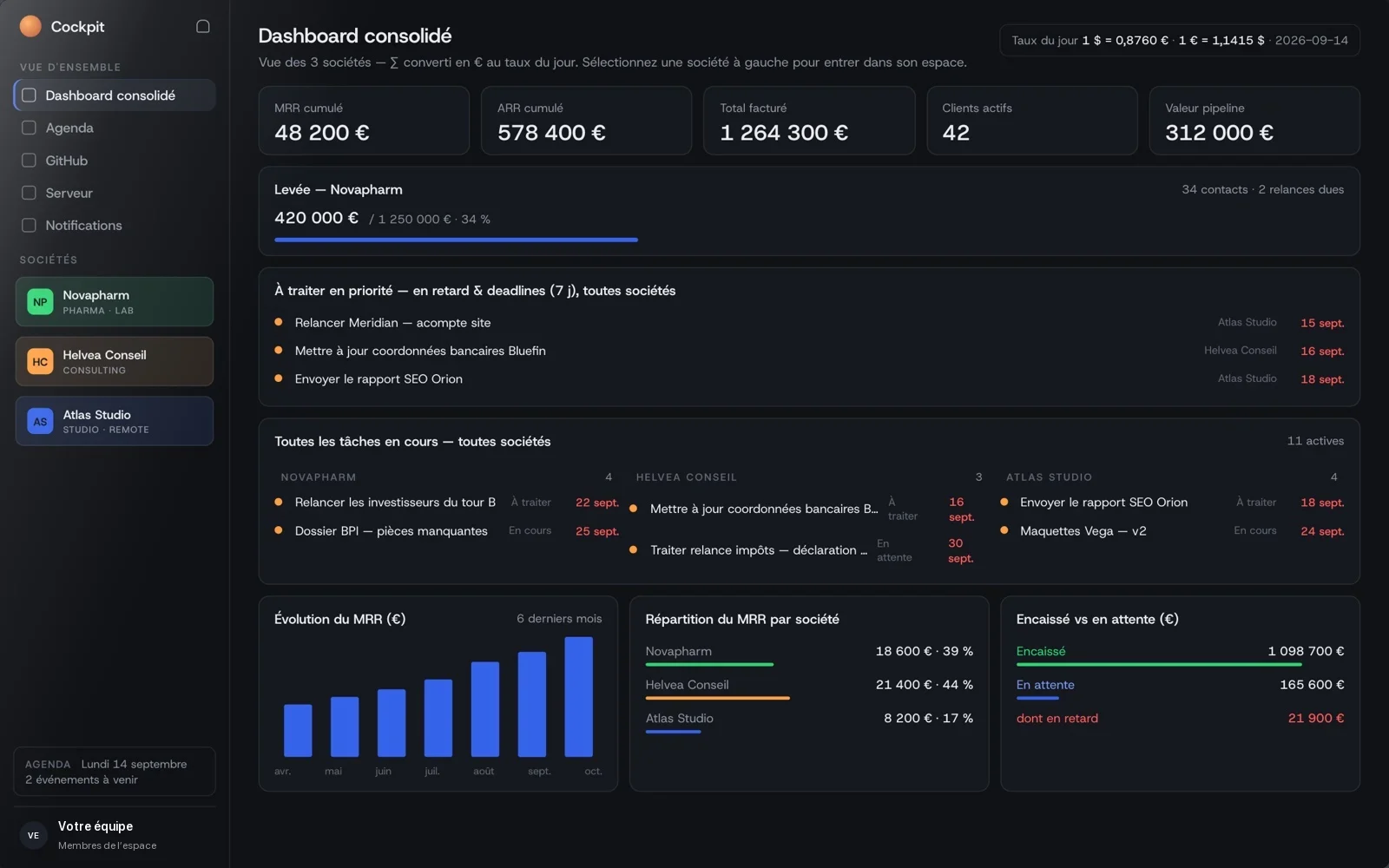
One web application: consolidated management of several companies, one space per company with about fifteen modules, profit and loss, cash and 12-month projection, calendar synced with Google Calendar, automatic SEO reports.
The result
All companies managed in a single interface, no more double entry or manual exports: every figure is up to date the moment you look at it.
Cockpit, OTTOPILOTE’s internal tool: about fifteen modules in a single interface.
1
interface for several companies
~15
modules per company space
4
tools replaced: Notion, Excel, CRM, invoicing
Frequently asked questions
What we get asked before signing.
Another question? Write to us: a human reply within one business day.
What is a custom web application?
Software accessed from a browser, without installation, designed for one company’s processes: accounts, data, business rules, connections to its tools. It differs from a website, which presents, and from off-the-shelf software, made for everyone.
Web application or business software, what is the difference?
A web application organises and shares information: client portal, dashboard, back office. Business software applies know-how: it calculates, checks and routes approvals according to your trade’s own rules, often in the form of a web application too. One project often mixes both; our “Custom business software” page covers the second case.
How much does a custom web application cost?
From €10,000 to €40,000 for an internal application (HR tool, dashboard, intranet), from €25,000 to €100,000 and up for a complex platform, depending on screens, roles, integrations and load. Then plan for maintenance: 30 days of fixes included, then an optional monthly upkeep plan, quoted. Our “How much does a website or an application cost” page details these ranges and offers an estimator.
How long does it take to develop a web application?
Six to eight weeks for a management tool or a dashboard, in weekly sprints with a demo every Friday. A larger project is cut into versions: the first in production quickly, the next ones based on real usage.
Can I administer the application myself?
Yes. Users, roles, settings, lists and document templates are managed without us, from the admin interface. The business logic stays in the code, versioned and documented, so an evolution does not break what works.
How do you handle security and maintenance?
Roles and permissions, encryption, tested backups, continuous monitoring and security updates. Thirty days of fixes are included after delivery; then optional monthly care covers fixes, evolutions and security.
Can you take over an existing application?
Yes, after an audit of the code and data. Depending on its state, we stabilise and evolve it, or rebuild it while keeping the data. Scoping tells which of the two costs less over three years.
Web application, PWA or mobile app?
A web application works on any device without installation. A PWA adds home-screen installation and offline mode, without going through the app stores. Native is justified when the app needs the phone’s capabilities or a presence in the App Store. For an internal tool or a client portal, a web application or a PWA is almost always enough.
Why not build the application with no-code?
No-code suits a prototype or a simple need. Its limits show up with volume, complex business rules, performance and platform dependency: the application lives at the vendor and cannot leave. For a tool that carries your business, we code a foundation assigned to you in writing, once the project is paid.
What do custom web application development services include?
Written scoping and validated mockups, the application itself, accounts, roles and permissions, connection to your existing tools, data migration, acceptance testing with your users, then hosting, backups and monitoring. The source code, access and documentation are handed over to you once the project is paid. After the 30 days of included fixes, maintenance is an optional monthly plan, quoted separately.
Going further
Scope the project, before writing code.
Three reads to arrive prepared: the full picture of custom development, what shipping a lean first version takes, and how we work.
 Cookies