A custom SaaS is software your customers pay for every month, and whose code is assigned to you in writing.
Custom SaaS development means designing, coding and running an online platform for your own market: your customers create an account, pay a subscription and use a tool that exists nowhere else. OTTOPILOTE builds this kind of platform for SMBs and founders, in France and the United States, from scoping to production.
What sets it apart.
Three things set it apart from classic software. A SaaS is multi-tenant: one installation serves all your customers, with strictly separated data. It sells by subscription: monthly recurring revenue replaces the one-off licence. And it runs as a service: hosting, updates and support are part of the price.
The right moment.
The right moment to build a custom SaaS: you already sell expertise your customers ask you to turn into a tool, you have an internal tool other companies would rent, or you carry a product idea whose core no existing solution covers. If an existing SaaS does 90% of the job, we will tell you in the first conversation.
Why an MVP first.
Across a panel of about 50,000 projects, the Standish Group counts only 31% of software projects as fully successful (CHAOS Report 2020). That is why we ship a tight MVP to production first, before widening the scope: what your first customers actually do with the tool decides what comes next, not the specification.
31%
of software projects fully successful, across a panel of about 50,000 projects.
Standish Group, CHAOS Report 2020
What we build
Four kinds of B2B SaaS, and a real example.
The platforms we build most often for SMBs and founders.
Vertical
The vertical SaaS for one industry
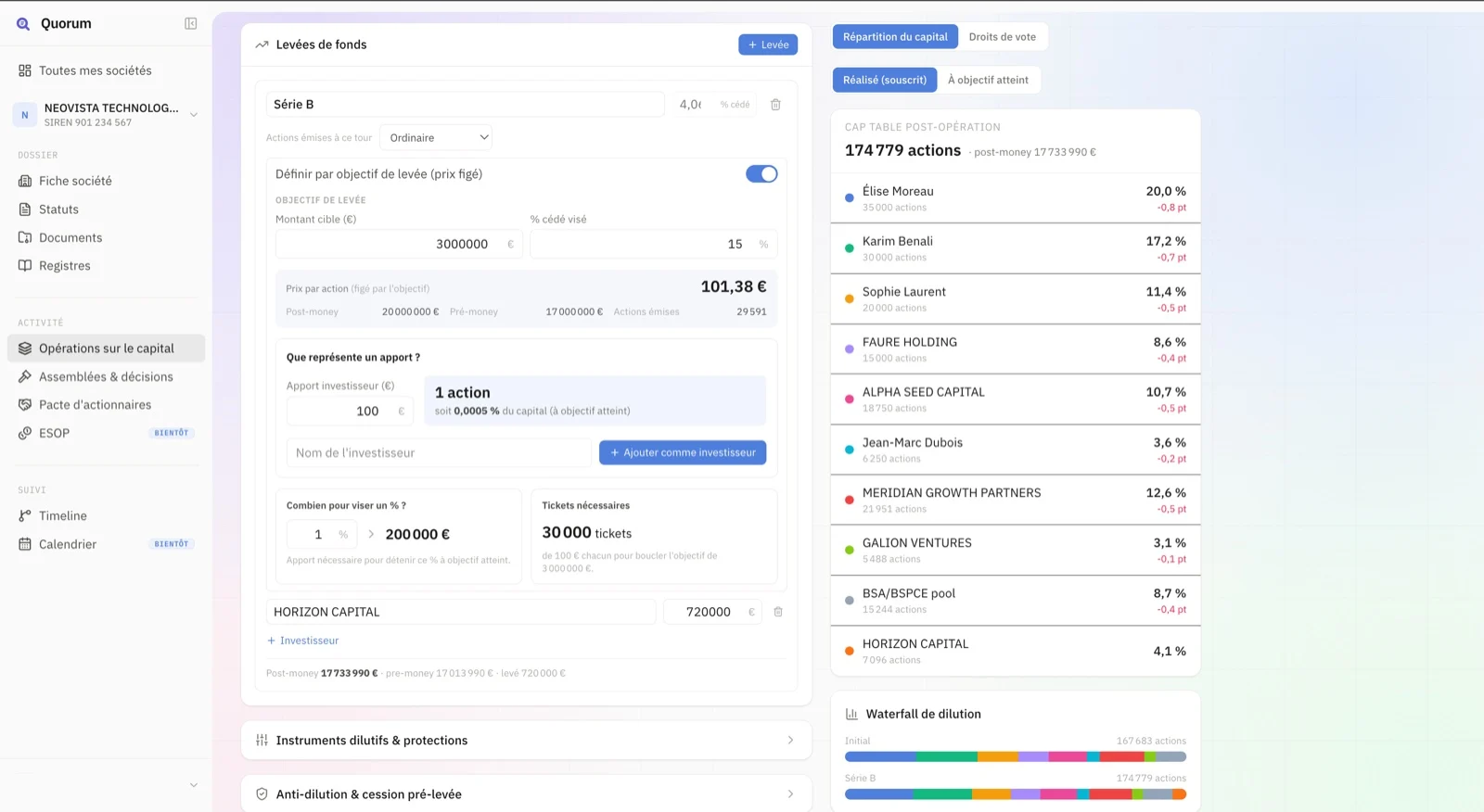
A tool that equips one profession: firms, agencies, tradespeople, clinics. Quorum, a legal SaaS built by OTTOPILOTE for a law firm, keeps its client companies’ records, capital and legal registers, and generates their articles of association.
DashboardFor your customers and for you: usage, revenue, MRR, activity.
API and integrationsConnections to your tools and to your customers’ tools: CRM, invoicing, calendars, webhooks.
GDPR complianceHosting in Europe or the United States depending on your market, consent, data export and deletion.
Hosting and monitoringContinuous deployment, monitoring, tested backups, a public status page.
Source code is yoursRights assigned in writing in the contract, code handed over at delivery once the project is paid, no dependency on us.
30 days of fixes after deliveryThen optional monthly care, with demos and a shared Slack.
Your SaaS · delivery9 items
Multi-tenant architecture
Accounts, roles and permissions
Stripe subscriptions and billing
Dashboard
API and integrations
GDPR compliance
Hosting and monitoring
Source code is yours
30 days of fixes after delivery
Process
Your project, step by step.
From the first conversation to the follow-up once you’re online. Five validation points, no grey areas: we write down every decision, and you keep control at each step. Twelve typical weeks.
Step 1 of 8W1
01W1
Scoping
We map your need and review what you already have. One clear document to start from.
Step 2 of 8W2 → W3
02W2 → W3
Design
The full design of your screens, validated together before we build.
Step 3 of 8W4 → W5
03W4 → W5
Build · foundations
The foundations and user accounts. You get a live preview at every step.
Step 4 of 8W6 → W7
04W6 → W7
Build · screens
The screens and the links to your tools. A demo every Friday, everything tracked in a shared space.
Step 5 of 8W8 → W9
05W8 → W9
Build · payments
Payments and finishing touches. We wire up billing and settle the last details one by one.
Step 6 of 8W10
06W10
Testing and sign-off
Full testing and sign-off with you. Speed and quality checked on every page.
Step 7 of 8W11
07W11
Launch
Going live and handover. Launch is a non-event: everything’s ready and reversible.
Step 8 of 8W12 →
08W12 →
Ongoing care
Continuous monitoring, fast security updates, and a public status page.
Technologies
A modern stack, chosen to last, not to impress.
The tools we use on our SaaS and on our own products. Proven, documented, hireable: your next developer will know them.
Your SaaS · technologies7 tools
NNext.jsInterface and API in one project
TSTypeScriptTyped code, fewer errors in production
The ranges published on our dedicated page, where an estimator places your project in four answers.
Custom SaaS MVP
from €12,000
A first version in production, tight scope, 4 to 6 weeks.
Full SaaS in production
€25,000 → €100,000+
Multi-user, integrations, ready for real load, 8 to 12 weeks.
Maintenance
Monthly plan, quoted
After 30 days of free fixes: fixes, evolutions, security, care.
Ranges published on our “How much does a custom SaaS cost” and “How much does a website cost” pages; maintenance: Pricing page. Free, capped quote within 24 hours.
Cockpit, our multi-company management tool, separates each company’s data, table by table. Every rule change is simulated account by account before it ships.
Billing gets tested on real cases.
In our own tool, a €300/month subscription with no commitment once showed as “€3,600” on a proposal: twelve months the customer never agreed to pay. A discount split across two invoices would have been applied twice. Those are the cases we test before your first customers.
No database update ships blind.
A successful release says nothing about the database. Since a database update stopped halfway on 19 September 2026, each one is first rehearsed on real data, then applied.
AI suggests, a person decides.
In our sales-proposal assistant, the model cannot even express a price, a quantity or a discount: it suggests lines, a person ticks them, nothing reaches the database without that person. We apply the same rule to the AI features of your products.
A capped quote, a demo every Friday.
The price is set before we start. You watch the product move forward every week in a shared space.
The code is assigned to you in writing.
Source code, access and documentation handed over at delivery, once the project is paid. You can leave with the product; you stay because it works.
B2B SaaS · Legal
Quorum, a legal SaaS in production since June 2026.
The problem
For a law firm, drafting deeds and reviewing its client companies’ legal files took a considerable amount of time, file after file.
What we built
A web platform in five modules: company and capital records, fundraising and cap table, shareholders’ agreement, legal registers, AI-assisted generation of articles of association.
The result
Delivered in June 2026 and used by the firm ever since. Its feedback: a considerable time saving on drafting and file review. No figure here: we only publish what has been measured.
Quorum, the legal SaaS built by OTTOPILOTE: fundraising and cap table.
June 2026
went live
5
business modules
AI
AI-drafted articles
Frequently asked questions
What we get asked before signing.
Another question? Write to us: a human reply within one business day.
How do you build a SaaS product?
In five moves: scope the problem and the paying customer, define a tight MVP, design the screens, build on a multi-tenant architecture with subscriptions, then ship to production and iterate with the first customers. At OTTOPILOTE, an MVP starts at 4 to 6 weeks, a full product at 8 to 12.
How much does a custom SaaS cost?
From €12,000 for an MVP in production, from €25,000 to over €100,000 for a full SaaS depending on scope, integrations and finish. Then plan for maintenance: 30 days of fixes included, then an optional monthly upkeep plan, quoted. Our “How much does a custom SaaS cost” page details the ranges and offers an estimator.
How long does it take to develop a SaaS?
Between 4 and 12 weeks depending on scope: an MVP in 4 to 6 weeks, a full product in production in 8 to 12. We work in weekly sprints with a demo every Friday.
What is the difference between SaaS and traditional software?
Traditional software is installed at each customer and sold by licence. A SaaS is hosted once for all customers, sold by subscription, and updated for everyone at the same time. For the publisher, that means recurring revenue and a single version to maintain.
Which tech stack for a SaaS?
We use Next.js and TypeScript for the interface and API, PostgreSQL via Supabase for data and authentication, Stripe for subscriptions, Vercel for hosting. Widespread, documented technologies: any developer can take over the project.
Where should a SaaS be hosted: does the server region matter?
More than server power. In September 2026, Cockpit, our management tool, was slow: the SQL query ran in 0.3 ms, but each round trip between the functions (Dublin) and the database (Falkenstein, 1,300 km away) cost 86 ms, so 850 ms for ten queries in a row. With the functions moved to Frankfurt, next to the database: 28 ms. Rewriting 52 queries, measured as well, changed nothing. The rule we apply to your projects: servers and database in the same region, as close to your users as possible.
How do you ensure security and GDPR compliance in a SaaS?
Through per-customer data separation from the architecture up, roles and permissions, audit logs, encryption in transit and at rest, tested backups, hosting in Europe or the United States depending on your market, and data export or deletion on request.
Can an existing tool be turned into a SaaS?
Yes, it is a common case: an internal tool, a spreadsheet that became critical, or a single-customer application. We take the business logic and make it multi-tenant, secure and billable. Scoping says what stays and what gets rewritten.
Why not build a SaaS with no-code, or alone with AI?
No-code gives you a prototype quickly and cheaply; beyond a few hundred users, its performance limits and per-user cost force a migration, and you pay for the product twice. AI speeds up development; it does not replace architecture, security or operations.
Is a SaaS eligible for the French innovation tax credit (CII)?
The CII is reserved for SMEs in the European sense and funds the design of prototypes of a new product, capped at €400,000 of expenses per year; the scheme runs until 31 December 2027 (source: Service-Public). A SaaS that is new on its market may qualify, an internal tool replicating existing functions does not. Ask your accountant.
Going further
Building a SaaS, without the missteps.
Three reads before the first line of code: what an MVP really covers, how a custom software project unfolds, and how we work.
 Cookies